
The KT-1000 knee arthrometer remains one of the best-known tools for quantifying sagittal knee laxity in suspected ACL injury, reconstructed ACLs, and follow-up after treatment. For clinicians interested in anterior knee laxity measurement, it offers a structured way to move beyond purely subjective examination. That said, current ligament assessment increasingly asks more of objective testing: repeatability, load standardization, stiffness data, and insight into rotational instability. This evidence summary reviews what the KT-1000 knee arthrometer measures well, where its practical limits lie, and what more recent instrumented systems may add when clinical questions extend beyond simple anterior translation.
1. KT-1000 knee arthrometer – what it was designed to measure
The KT-1000 knee arthrometer was developed to quantify anterior tibial translation relative to the femur, typically as a side-to-side comparison. In practical terms, it supports ACL arthrometer testing by providing a numerical estimate of anterior displacement under applied force.
Its clinical role fits best with the broader examination rather than replacing it. A Lachman test, pivot shift, history of giving way, effusion pattern, and MRI findings still matter. If you want a refresher on the basics of the KT-1000 test itself, that context helps frame the device’s original purpose.
In day-to-day use, the KT-1000 knee arthrometer is commonly used for:
- Baseline ACL injury assessment
- Post-operative side-to-side follow-up
- Research protocols using instrumented displacement values
- Documenting change over time in instrumented knee laxity
The core strength of the KT-1000 knee arthrometer is simplicity. It focuses on one clinically relevant domain: sagittal laxity. For some patients, that is enough. In isolated ACL deficiency with a clear examination, the KT-1000 knee arthrometer may help objectify findings already suspected clinically.
2. How to interpret KT-1000 knee arthrometer findings in practice
The most useful output from the KT-1000 knee arthrometer is usually the side-to-side difference rather than a single raw value in isolation. That is because body habitus, guarding, hamstring activation, positioning, and examiner technique can influence absolute measurements.
Clinically, interpretation should answer four questions:
- Is there measurable asymmetry?
- Does it match the patient’s symptoms and manual exam?
- Is the pattern consistent with isolated ACL laxity or a more complex injury?
- Would MRI clarify associated meniscal, chondral, or bone injury?
The KT-1000 knee arthrometer may be most informative when paired with standard examination maneuvers. This is especially true when trying to reconcile a soft Lachman with a negative pivot shift, or vice versa. A useful clinical bridge between manual testing and device-based assessment is outlined in this discussion of clinical decision making.
A key limitation is that the KT-1000 knee arthrometer does not capture the whole biomechanical story. Some patients with instability complaints have modest anterior translation but clinically meaningful rotational symptoms. Others may show measurable displacement without major functional instability. That gap matters in return-to-sport decisions, revision evaluation, and partial tears.
2.1 Common interpretation pitfalls
Several factors can reduce confidence in KT-1000 knee arthrometer readings:
- Poor patient relaxation
- Hamstring guarding during testing
- Inconsistent force application
- Difficulty reproducing positioning between sessions
- Over-reliance on a number without clinical context
These issues explain why discussion of KT-1000 reliability remains clinically relevant even though the device has been used for decades.
3. Where the KT-1000 knee arthrometer shows its limits
The KT-1000 knee arthrometer still has historical value, but its weaknesses become clearer when clinicians need more standardized and nuanced assessment. In many modern pathways, the question is not simply whether anterior translation exists. The question is whether the test can characterize instability in a way that is reproducible, decision-relevant, and sensitive to partial injury patterns.
The major KT-1000 limitations include:
- Manual force dependence, which can affect reproducibility
- Limited information on load-displacement behavior
- No direct quantification of objective dynamic laxity testing
- Minimal insight into rotational or multiplanar instability
- Potential variability across users and experience levels
For readers comparing legacy and newer systems, this comparative analysis gives additional context, while this overview on why some clinics upgrade from older KT platforms highlights the practical reasons.
These constraints are especially relevant in three scenarios:
- Partial ACL tears, where static translation may not fully reflect instability
- Borderline MRI findings, where functional asymmetry may help clarify concern
- Complex instability, including meniscal deficiency, revision ACL, or combined ligament injury
Even in these cases, arthrometry should be framed carefully. It may help clarify equivocal presentations, but it does not replace MRI. MRI remains complementary and is typically needed to assess meniscal, cartilage, osseous, and other associated injuries, as well as for pre-operative planning when reconstruction is being considered.
4. What newer arthrometers add beyond the KT-1000 knee arthrometer
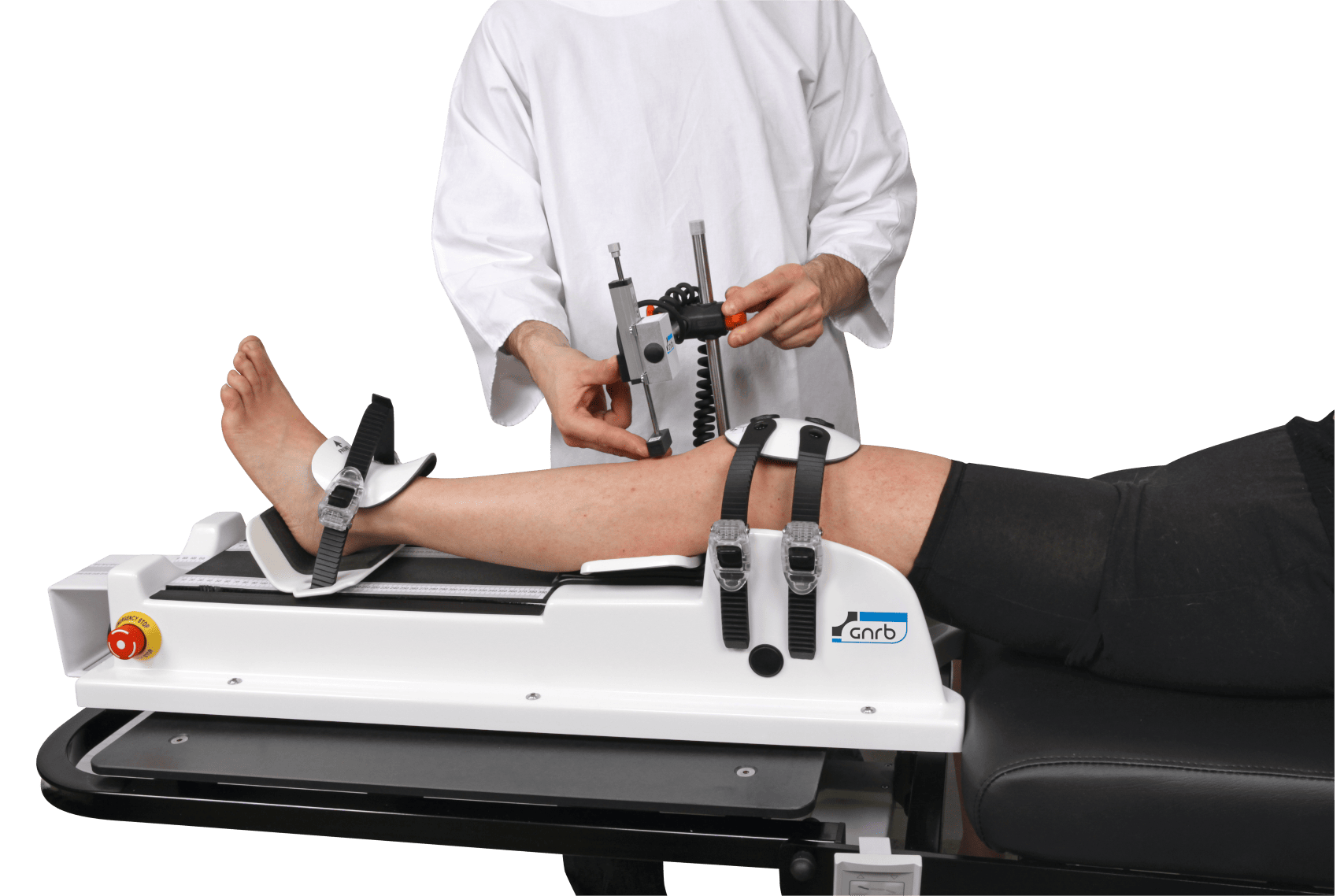
Modern systems were developed not just to replicate the KT-1000 knee arthrometer, but to improve standardization and extend what can be measured. This is where a true GNRB arthrometer comparison becomes useful: the question is less about old versus new branding, and more about whether the device captures clinically meaningful data with better reproducibility.
Recent studies have focused heavily on the GNRB platform. Unal et al. (2024) evaluated inter- and intra-observer reliability and the learning curve, while Smith et al. (2022) examined reliability for both ACL stiffness and laxity. Magdič et al. (2023) also reported intra-rater reliability for anterior laxity in healthy active subjects. Collectively, these studies support the idea that more standardized force application and measurement workflows may improve consistency in anterior knee laxity measurement.
Diagnostic value is also part of the story. Cojean et al. (2023) studied the GNRB with MRI in clinical practice for complete and partial ACL tear detection, with arthroscopic validation. That is important because partial ACL injury is one of the most difficult areas for any isolated test. Objective laxity testing may provide added functional information in suspected partial tears or equivocal MRI cases, but MRI still remains necessary to assess associated pathology and surgical planning needs.
From a feature standpoint, newer systems may add:
- More standardized force delivery
- Load-displacement curve analysis
- Compliance or stiffness metrics
- Improved serial follow-up consistency
- Potential integration into multi-axis workflows
Those added metrics matter because not all unstable knees behave the same under load. Looking only at endpoint displacement can miss differences in tissue behavior across the loading curve. This is why interest is growing in stiffness and compliance, not just endpoint laxity.
5. Dyneelax and the move toward dynamic, multi-axis evaluation
The KT-1000 knee arthrometer is fundamentally a sagittal laxity tool. By contrast, newer robotic approaches aim to characterize instability in a broader, more standardized way. This matters because patient complaints often involve pivoting, cutting, deceleration, or giving-way events that are not purely anterior in nature.
Among the relevant Dyneelax arthrometer studies, Nascimento et al. (2024) reported on reliability and feasibility of the DYNEELAX robotic arthrometer in healthy individuals and ACL-injured or reconstructed persons. That paper is especially useful because it speaks directly to whether a robotic arthrometer can be deployed reliably across clinically relevant groups. For a more focused summary, see this page on Dyneelax reliability.
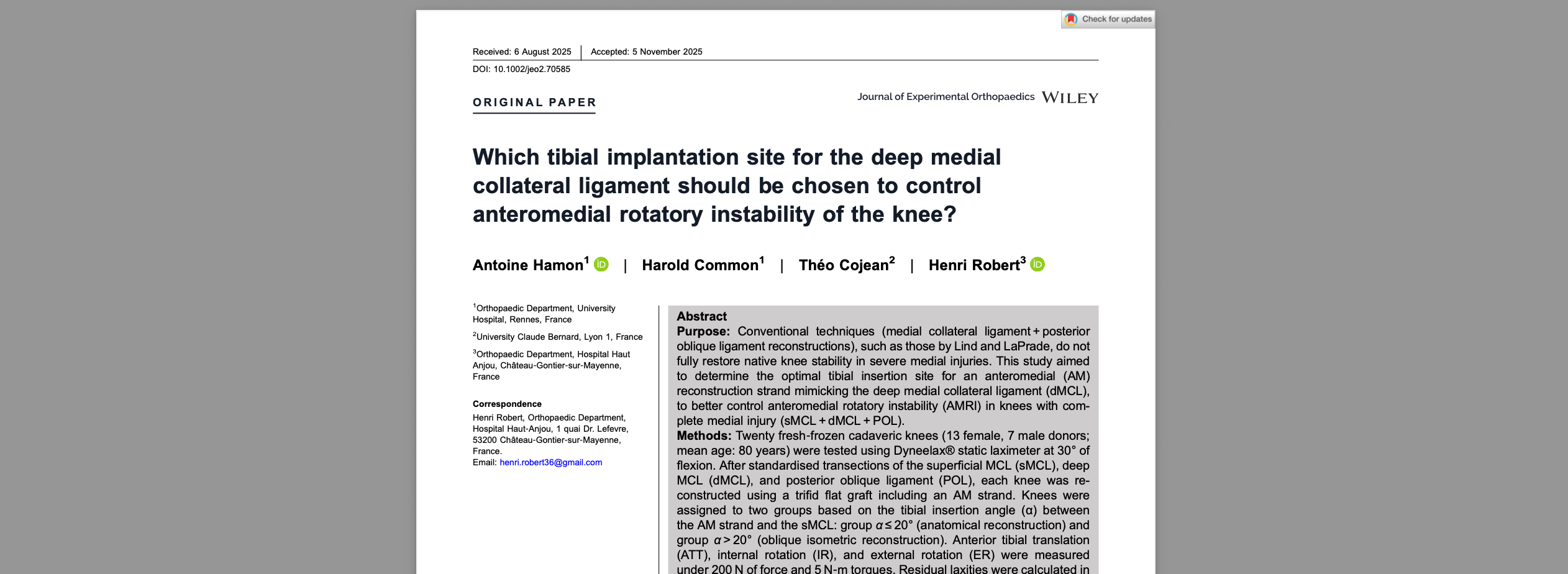
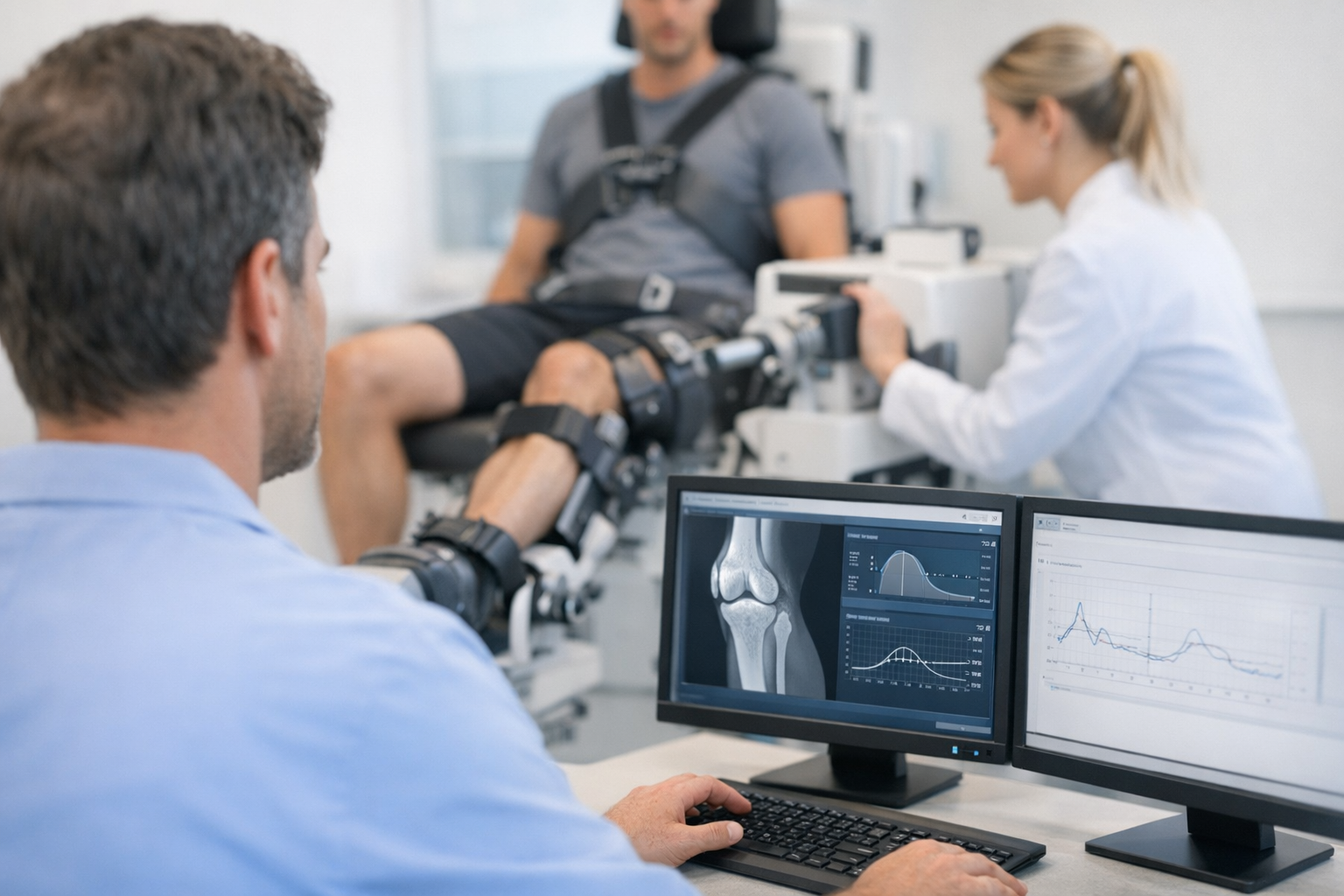
Unlike the KT-1000 knee arthrometer, some modern systems are designed to support broader stability analysis. This may include multiplanar assessment and workflow integration for complex ligament patterns. If you want a visual overview of what a newer platform may add, this tutorial video is relevant, and this overview of multi-axis testing gives further clinical context.
In practice, the distinction is straightforward:
- KT-1000 knee arthrometer: mainly anterior translation
- Newer robotic systems: may add standardized loading, dynamic response, stiffness data, and broader motion-plane analysis
Where rotational instability is a concern, especially in high-demand athletes or revision settings, clinicians often need more than sagittal translation values. Quantifying the pivot shift and related rotational behavior may better reflect the instability patients actually feel.
6. Where instrumented laxity testing fits in a modern clinical pathway
Objective testing works best when used as a complement to clinical examination and MRI, not as a standalone answer. For many specialists, the practical question is not whether to use arthrometry, but when each device adds enough value to justify workflow change.
A simple decision aid may help:
- Start with history and exam – mechanism, swelling, giving way, Lachman, pivot shift, collateral testing.
- Add MRI when structural definition is needed – especially for meniscus, cartilage, bone bruising, or surgical planning.
- Use instrumented testing when objective quantification could change decisions – baseline ACL status, follow-up, partial tear suspicion, revision evaluation, research, or return-to-sport tracking.
- Escalate to broader assessment if symptoms suggest more than anterior laxity – rotational complaints, complex combined injury, posterolateral concerns, or equivocal findings.
For clinics considering implementation, a broad overview of knee laxity testing can be useful before selecting a specific pathway. In device-specific terms, clinicians comparing a GNRB arthrometer with a Dyneelax arthrometer should focus on the clinical question being asked: pure anterior translation, serial standardization, stiffness behavior, or rotational and multi-axis characterization.
For the right patient, objective measurement may shorten uncertainty, quantify side-to-side instability, and support communication across surgeons, sports physicians, physiotherapists, and researchers. But diagnosis and treatment decisions should remain clinician-led and should integrate symptoms, examination, imaging, activity goals, and associated injury patterns.
7. Key takeaways and next steps
The KT-1000 knee arthrometer still matters because it helped establish objective ACL arthrometer testing as part of knee instability evaluation. It remains useful for measuring anterior translation and documenting side-to-side differences. However, the KT-1000 knee arthrometer has important limits in standardization, stiffness profiling, and characterization of rotational or complex instability.
Newer systems, including those evaluated in GNRB and DYNEELAX studies, may add more reproducible loading, richer biomechanical data, and a broader view of instrumented knee laxity. That does not make older tools irrelevant. It simply means the best device depends on the question being asked.
Practical bottom line: use the KT-1000 knee arthrometer when a straightforward anterior translation measure is enough. Consider more advanced testing when you need better standardization, serial monitoring, partial ACL clarification, or insight into rotational instability. In all cases, objective laxity testing should complement clinical examination and MRI rather than attempt to replace either one.
Clinical references (PubMed)
1) 2024 – Nascimento et al. – DYNEELAX Robotic Arthrometer Reliability and Feasibility on Healthy and Anterior Cruciate Ligament Injured/Reconstructed Persons. – Transl Sports Med – DOI: 10.1155/2024/3413466 – PMID: 38654720 – PubMed
2) 2024 – Unal et al. – GNRB® Knee Arthrometer: Inter- and Intra-observer Reliability and Learning Curve. – Cureus – DOI: 10.7759/cureus.70838 – PMID: 39493172 – PubMed
3) 2023 – Cojean et al. – GNRB® laximeter with magnetic resonance imaging in clinical practice for complete and partial anterior cruciate ligament tears detection: A prospective diagnostic study with arthroscopic validation on 214 patients. – Knee – DOI: 10.1016/j.knee.2023.03.017 – PMID: 37172464 – PubMed
4) 2022 – Smith et al. – The Reliability of the GNRB® Knee Arthrometer in Measuring ACL Stiffness and Laxity: Implications for Clinical Use and Clinical Trial Design. – Int J Sports Phys Ther – DOI: 10.26603/001c.38252 – PMID: 36237656 – PubMed
5) 2023 – Magdič et al. – Intra-rater reliability of the knee arthrometer GNRB® for measuring knee anterior laxity in healthy, active subjects. – J Orthop – DOI: 10.1016/j.jor.2023.03.016 – PMID: 37089624 – PubMed