
post-ACL reconstruction monitoring in high-risk athletes should be planned, not improvised. For clinicians managing cutting, pivoting, or contact sport populations, a structured pathway helps distinguish expected recovery from early graft overload, persistent instability, or reinjury risk. This is especially relevant in high-risk athletes after ACL reconstruction, where return timelines, exposure load, and residual laxity may not move in parallel. A practical workflow should combine symptoms, exam findings, function, and objective comparison over time, rather than relying on a single visit or a single criterion.
1. Why post-ACL reconstruction monitoring needs a workflow in high-risk sport
High-risk athletes often progress quickly in rehabilitation, but tissue biology, neuromuscular control, and knee stability do not always normalize at the same pace. That is why post-ACL reconstruction monitoring is most useful when it is serial, side-to-side, and tied to clinical decisions.
A workflow matters because the main questions change over time:
- Early phase: Is the knee settling as expected, or is there excessive effusion, extension loss, or early instability?
- Mid phase: Is the athlete reaching rehab targets without signs of increasing laxity or rotational symptoms?
- Late phase: Is return to sport supported by objective stability, not just time since surgery?
- After RTS: Are there subtle warning signs of graft stretch, recurrent pivoting symptoms, or declining control under load?
This is where objective knee examination becomes valuable. Reproducible documentation across visits helps clinicians compare trends, not isolated impressions. It also strengthens communication between surgeon, sports physician, physiotherapist, and performance staff.
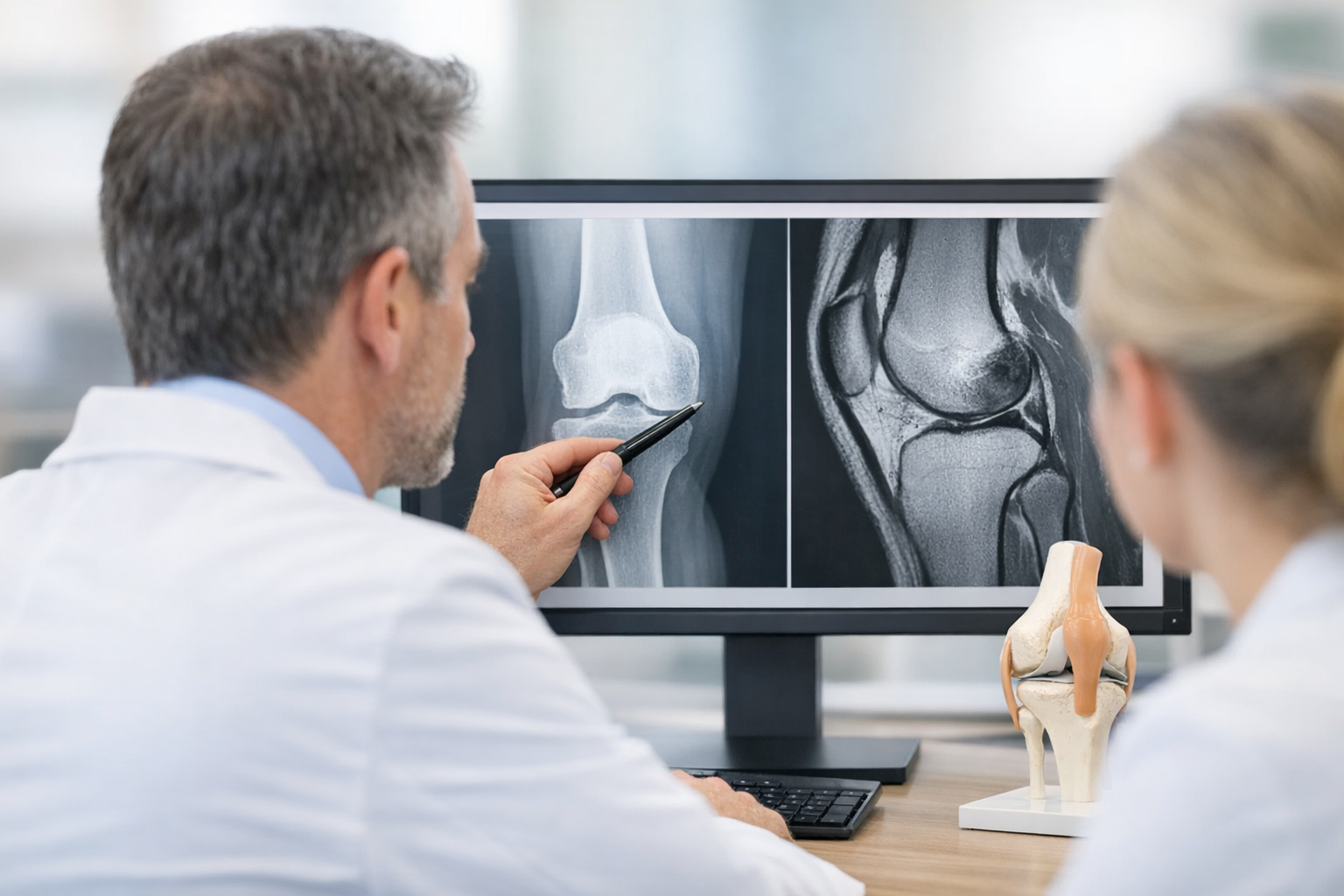
For athletes with suspected rotational symptoms, repeat giving-way episodes, or equivocal progression, a dynamic testing approach may add functional information that static observation alone can miss. This does not replace MRI, which remains complementary for meniscal, chondral, bone, and associated ligament evaluation.
2. Baseline visit: what to capture for meaningful serial comparison
The baseline for post-ACL reconstruction monitoring is not necessarily the first post-op day. Clinically, the most useful baseline is the earliest visit at which swelling, guarding, and pain allow repeatable measurement and examination. The goal is to establish a reference for serial ACL assessment.
2.1 Core baseline domains
A practical ACL baseline testing visit should document:
- Effusion and pain irritability
- Active and passive extension and flexion
- Quadriceps activation and gross asymmetry
- Lachman, anterior drawer, and pivot-related findings when appropriate
- Symptoms of giving way, mistrust, or instability during direction change
- side-to-side knee laxity difference when testing is reliable
- Functional tolerance to closed-chain loading
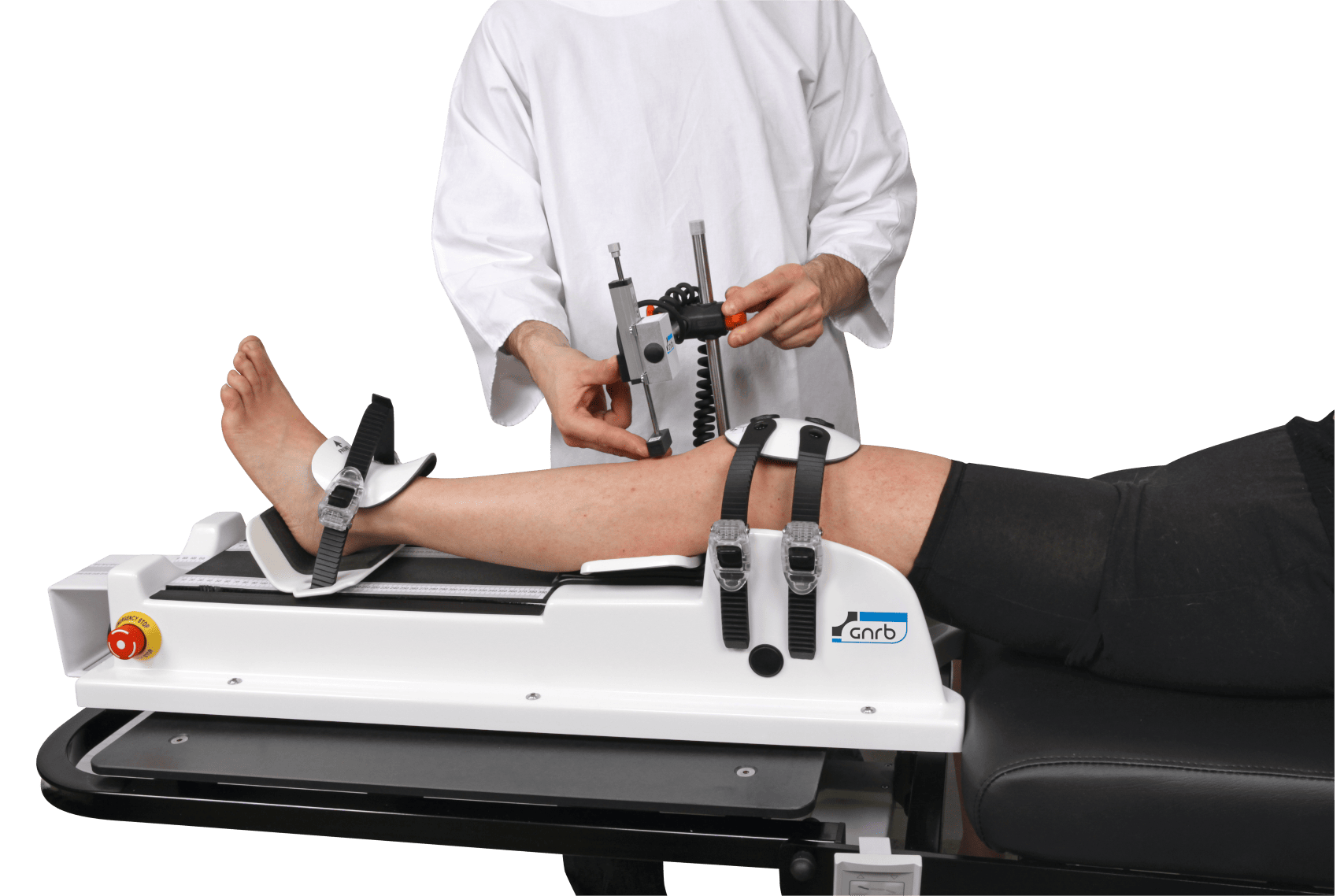
Foundational principles for repeat measures are well outlined in knee laxity testing. The key is consistency: same positioning, same force application standards where possible, and the same interpretation framework across visits.
At baseline, clinicians should also define the athlete’s risk profile. Important modifiers include age, graft type, hypermobility, generalized laxity, meniscal status, associated anterolateral or posterolateral concerns, sport demands, and previous contralateral ACL injury. In younger athletes, adjunctive procedures may influence interpretation of expected stability profile. This is relevant to the systematic review by Kienberger et al. (2026), which examined lateral extra-articular procedures and graft failure reduction in patients younger than 21 years undergoing primary ACL reconstruction.
If the athlete had primary repair rather than reconstruction, monitoring logic is similar but context matters. Failure patterns, tissue behavior, and symptom interpretation may differ. That nuance is highlighted by Carrozzo et al. (2026), who reported outcomes after primary ACL repair for acute proximal tears.
2.2 When objective laxity metrics add value
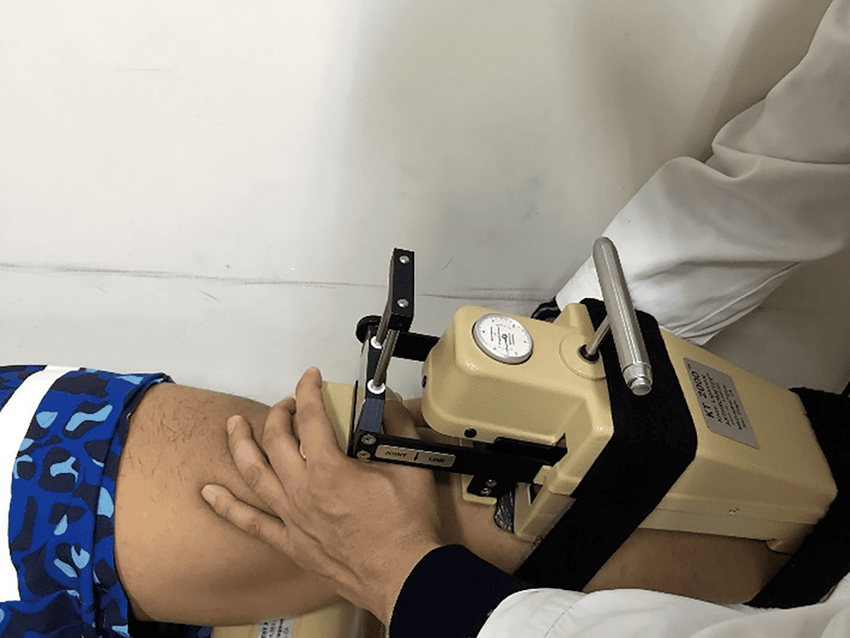
In high-risk athletes, objective knee laxity monitoring is most useful when the result changes management, such as confirming stable progression, clarifying concern after a symptom flare, or supporting delayed return decisions. In some clinics, instrumented testing with a robotic ACL arthrometer or dynamic knee arthrometer may help quantify side-to-side behavior over time and complement the manual exam.
Where such testing is used, clinicians should avoid treating one value as a diagnosis in isolation. Objective measures complement MRI and clinical examination by adding quantified functional instability data, particularly in borderline cases or when symptoms and time-based progression do not match.
3. A practical ACL follow-up schedule for high-risk athletes
An ACL follow-up schedule should track biological recovery, rehab progression, and sport exposure. For post-ACL reconstruction monitoring, the exact timing may vary by graft choice, associated procedures, and sport, but the logic should remain consistent.
3.1 Suggested workflow checkpoints
Checkpoint 1: Early settling phase
Focus on pain, swelling, extension, quadriceps recruitment, and whether the knee is becoming testable. Large irritability or recurrent swelling after low-load rehab may justify closer review.
Checkpoint 2: Strength and load-building phase
Reassess symptoms, exam quality, and whether loading progression matches stability. This is an ideal point to align testing with rehab milestones rather than time alone.
Checkpoint 3: Running, cutting, and advanced field work
This phase is critical for post-ACL reconstruction monitoring because subjective confidence can improve before stability deficits fully normalize. Recurrent swelling, loss of terminal extension after load, or instability with deceleration should not be dismissed.
Checkpoint 4: Return-to-sport decision window
Use a combined framework of symptoms, function, exposure tolerance, and RTS criteria. This is where objective stability data can sharpen risk discussion, especially in elite or pivot-heavy athletes.
Checkpoint 5: Early post-RTS surveillance
The first months after return may reveal issues that were not obvious in clinic testing. post-ACL reconstruction monitoring should continue after clearance, not end at clearance.
Clinically, the purpose of each checkpoint is simple: identify whether the athlete is following the expected trajectory, plateauing, or drifting into a red-flag pattern. That is particularly relevant because Mazza et al. (2026) reported secondary muscle injuries and performance decline after ACL reconstruction in professional soccer, reminding clinicians that successful surgery does not guarantee normal load tolerance or performance behavior.
4. How to interpret changes over time: stable progress, drift, or true concern
Good post-ACL reconstruction monitoring is less about one number and more about the direction of travel. A knee can look acceptable at one visit yet still be trending the wrong way.
Three broad patterns are useful:
- Stable recovery: symptoms improving, swelling controlled, confidence rising, no progressive laxity concerns.
- Monitoring drift: subtle increase in symptoms, small decline in tolerance, intermittent mistrust, or changing exam quality without a clear traumatic event.
- Red-flag instability: recurrent giving way, rising side-to-side knee laxity difference, clear rotational symptoms, or new traumatic onset.
In athletes with hamstring autograft ACL reconstruction, residual anterior laxity at one year may carry meaningful prognostic information. Erden et al. (2026) reported that increased residual anterior knee laxity at one year was associated with a dose-dependent increase in graft re-rupture risk in athletes. For clinicians, this supports the logic of objective knee laxity monitoring during later follow-up, especially when considering unrestricted pivot sport exposure.
It is also worth looking beyond absolute displacement alone. In some athletes, altered load-deformation behavior may suggest subtle graft or soft-tissue change before the clinical picture becomes obvious. That is why stiffness metrics can be useful in selected pathways.
If increasing anterior translation appears without a major new injury, do not assume immediate graft rupture. The differential may include testing variability, effusion-related guarding change, progressive graft stretch, fixation concern, associated meniscal deficiency, or technical factors. A structured interpretation pathway is outlined in graft stretch.
4.1 A short decision aid for interval change
- Confirm whether the change is reproducible on repeat exam or repeat testing.
- Check for a recent load spike, contact episode, hyperextension event, or new effusion.
- Compare symptoms with function: is the athlete only sore, or actually unstable?
- Assess for rotational instability after ACL, not just anterior translation.
- If concern persists, escalate with clinician-led imaging and further work-up.
Where multi-planar concerns exist, a multi-axis workflow may help organize assessment, especially when sagittal findings alone do not explain the athlete’s complaints.
5. Red flags that should change management
Not every symptom spike is dangerous, but some patterns during post-ACL reconstruction monitoring should prompt a slower progression, deeper evaluation, or both.
return to sport ACL red flags commonly include:
- Recurrent giving-way episodes, especially with pivot or deceleration
- New traumatic event followed by swelling and instability
- Worsening manual exam or measurable increase in laxity over serial visits
- Persistent apprehension despite strength gains
- Mechanical symptoms suggesting associated meniscal pathology
- Loss of extension or recurrent effusions after sport-specific loading
- Visible movement asymmetry with cutting, landing, or split squat tasks
Rotational symptoms deserve particular attention. Persistent or new rotational instability after ACL may indicate residual anterolateral insufficiency, graft compromise, technical issues, or combined pathology. If the athlete shows a notable pivot-related exam finding, the next step should be clinician-led reassessment rather than automatic progression. For that scenario, see pivot shift.
Movement analysis can also add context. Lee et al. (2026) examined short-term and long-term in vivo 3D knee kinematics during split squat after ACL reconstruction, supporting the idea that movement quality and joint behavior may remain altered over time even when gross clinical progression appears acceptable.
If red flags accumulate, the clinician should consider whether the athlete is experiencing overload, partial failure, associated injury, or early relapse. Broader patterns of concern are summarized in reinjury signs.
6. Closing the loop: how monitoring should guide decisions, not just documentation
The main purpose of post-ACL reconstruction monitoring is decision support. It should influence progression, imaging referral, return-to-sport timing, and the threshold for specialist review. In high-level athletes, that means using a repeatable process rather than relying on time from surgery, hop scores alone, or confidence alone.
Key takeaways for clinical teams:
- Build an early, reproducible baseline and keep the same framework across visits.
- Use an ACL follow-up schedule tied to phase-specific decisions, not calendar milestones only.
- Track serial ACL assessment trends, because interval change often matters more than one isolated result.
- Do not ignore subtle increases in side-to-side knee laxity difference, recurrent swelling, or pivoting mistrust.
- Use objective knee laxity monitoring as a complement to MRI and clinical examination when it may change management.
For clinicians managing high-risk athletes after ACL reconstruction, the best workflow is one that stays flexible but disciplined. If findings are stable, progression can continue with confidence. If trends drift, tighten surveillance. If clear instability red flags emerge, reassess early and thoroughly before the next exposure step. That is the practical value of structured post-ACL reconstruction monitoring.
Clinical references (PubMed)
1) 2026 – Erden et al. – Increased residual anterior knee laxity at one year is associated with a dose-dependent increase in graft re-rupture risk following hamstring autograft ACL reconstruction in athletes. – Knee Surg Sports Traumatol Arthrosc – DOI: 10.1002/ksa.70447 – PMID: 42139640 – PubMed
2) 2026 – Mazza et al. – Secondary Muscle Injuries and Performance Decline After Anterior Cruciate Ligament Reconstruction in Professional Soccer: A Retrospective Matched Cohort Study. – Am J Sports Med – DOI: 10.1177/03635465261441252 – PMID: 42157579 – PubMed
3) 2026 – Lee et al. – Short-term and long-term in vivo 3D kinematics of the knee joint during split squat after anterior cruciate ligament reconstruction. – Clin Biomech (Bristol) – DOI: 10.1016/j.clinbiomech.2026.106861 – PMID: 42061204 – PubMed
4) 2026 – Kienberger et al. – Lateral Extra-Articular Procedures Reduce Anterior Cruciate Ligament Graft Failure in Patients Younger than 21 Years Undergoing Primary Anterior Cruciate Ligament Reconstruction: A Systematic Review. – J ISAKOS – DOI: 10.1016/j.jisako.2026.101139 – PMID: 42142710 – PubMed
5) 2026 – Carrozzo et al. – Primary Anterior Cruciate Ligament Repair for Acute Proximal Tears Shows High Return to Sport and a 10% Failure Rate at a Minimum 2-Year Follow-Up. – Arthroscopy – DOI: 10.1002/arj.70218 – PMID: 42138151 – PubMed