
ACL tear vs meniscus tear is a common but clinically important distinction in acute and subacute knee assessment. In practice, the challenge is not simply naming the injured structure. It is deciding whether the patient’s main problem is instability, locking, pain, swelling, or a combined injury, and then choosing the next diagnostic step. For clinicians trying to differentiate ACL and meniscus injury, the most useful clues usually come from mechanism, timing of effusion, mechanical symptoms, and focused examination. MRI often helps define associated pathology, but bedside pattern recognition still drives early decision-making, especially in sports medicine, emergency settings, and first specialist review.
1. ACL tear vs meniscus tear: the quickest practical distinction
The simplest frame for ACL tear vs meniscus tear is this: ACL injury more often presents as a problem of instability, while meniscal injury more often presents as a problem of mechanical symptoms and joint line pain. That distinction is not perfect, but it is highly useful in clinic.
In an acute pivoting injury with a pop, rapid swelling, and inability to trust the knee, think ACL first. In a twisting or deep-flexion injury with focal joint line pain, painful catching, and a sense that the knee cannot fully move through range, think meniscus first. A helpful overview of early pattern recognition is covered in this overview.
That said, ACL tear vs meniscus tear is often not an either-or diagnosis. Combined injury is common. Meniscal damage, including ramp lesions and root tears, may accompany ACL rupture and materially change management. Familiari et al. (2025) highlighted MRI bone bruise patterns that may predict ramp lesions in ACL-injured knees, while Batta et al. (2025) reviewed the clinical importance of ramp tears and why they may be missed if clinicians focus only on the ACL.
1.1 Key symptom contrast
- ACL pattern: pop, collapse, rapid swelling, giving way, poor confidence on cutting or deceleration
- Meniscus pattern: joint line pain, clicking, catching, painful squat, delayed swelling, intermittent block to motion
- Combined pattern: hemarthrosis plus instability plus persistent mechanical symptoms
When comparing ACL tear vs meniscus tear, one of the most clinically useful symptom questions is whether the patient describes laxity or whether they describe something physically obstructing motion.
2. History clues that separate instability from locking
History often narrows ACL tear vs meniscus tear before the clinician even touches the knee. Mechanism and timing matter.
Acute hemarthrosis ACL injury is a classic pattern. Rapid swelling within hours after a non-contact pivot, valgus-rotation event, or awkward landing raises suspicion for ACL rupture. By contrast, many isolated meniscal tears produce swelling later, often over the next 12 to 24 hours, although exceptions occur.
The symptom phrase knee locking vs instability symptoms should be taken literally. A patient with ACL deficiency usually says the knee “gives way,” “shifts,” or “does not feel stable.” A patient with meniscal pathology more often says the knee “catches,” “locks,” or “will not straighten.” True locking suggests a mechanical block, although pain inhibition can mimic locking and must be distinguished on exam.
Clinical triage is especially important in urgent settings. If the knee is grossly swollen, the patient cannot bear weight, or there is concern for extensor mechanism injury, fracture, dislocation, neurovascular compromise, or septic process, a structured triage workflow is often more important than immediately settling the finer points of ACL tear vs meniscus tear.
2.1 History questions that change your differential
- Did the patient feel a pop?
- How quickly did swelling appear?
- Is the key complaint giving way or locking?
- Is there a pivoting mechanism or a deep-flexion twist?
- Can the patient fully extend the knee?
- Are symptoms persistent despite swelling improving?
If instability dominates, move up the ACL pathway. If mechanical block and joint line pain dominate, move up the meniscal pathway. If both are present, assume combined injury until proven otherwise. This is where ACL tear vs meniscus tear becomes a management question, not just a labeling exercise.
3. Examination: which tests help most, and where do they mislead?
Examination is still the clinical core of ACL tear vs meniscus tear. In acute knees, pain, guarding, and effusion lower confidence in all maneuvers, so interpretation should remain cautious.
For suspected ACL injury, Lachman test accuracy remains central. A practical summary of major maneuvers appears in these key tests, and a deeper breakdown is available in this Lachman guide. The broad point from Nguyen et al. (2025) is that clinical tests remain valuable, but performance depends on timing, examiner experience, and whether the tear is complete, partial, or masked by guarding.
For rotational control, pivot shift test interpretation is highly informative when positive, but it is difficult in acute painful knees and often underused without adequate relaxation. A positive pivot shift pushes the clinician strongly toward functional ACL deficiency rather than an isolated meniscal lesion.
For meniscal injury, clinicians commonly ask about McMurray test sensitivity specificity and whether Thessaly test meniscal tear assessment is worth using in routine practice. The answer is that both can help, but neither should be treated as a stand-alone rule-in or rule-out test. McMurray may support a meniscal diagnosis when it reproduces pain or a palpable click at the joint line, but sensitivity is variable in real-world settings. Thessaly can be useful in cooperative, weight-bearing patients, yet it may be impractical or too painful in the acute phase.
3.1 A practical reading of the exam
- Lachman positive, pivot shift positive: ACL injury is more likely than isolated meniscal injury
- Joint line tenderness, painful McMurray, extension block: meniscal pathology becomes more likely
- Large effusion with guarding: re-examine after pain and swelling settle if initial tests are equivocal
- Persistent rotational symptoms despite “normal” basic exam: look harder for subtle ACL deficiency and associated meniscal lesions
For a broader assessment framework beyond single maneuvers, this objective knee exam article is useful in reducing tunnel vision when facing ACL tear vs meniscus tear.
4. MRI findings, combined injuries, and when the picture is not clean
MRI findings ACL and meniscus tear are highly relevant when the clinical picture is mixed, symptoms persist, or surgery is being considered. In ACL tear vs meniscus tear, MRI helps define associated meniscal, chondral, and bone injury that bedside examination cannot fully characterize.
Still, MRI does not eliminate the need for clinical interpretation. Borderline or equivocal scans occur, especially in partial ACL injuries or when signal abnormality does not match functional symptoms. In those cases, the MRI should be integrated with mechanism, examination, and follow-up testing rather than treated as the single deciding factor. This is discussed further in MRI vs arthrometer and in this borderline ACL cases workflow.
The reason this matters in ACL tear vs meniscus tear is that some meniscal lesions are strongly linked to ACL-deficient biomechanics. Familiari et al. (2025) suggested that certain high-grade medial compartment bone bruise patterns on MRI may predict ramp lesions in ACL tears. Batta et al. (2025) emphasized that ramp tears can affect knee stability and may be clinically consequential if missed.
Rare and complex combinations also remind us not to oversimplify ACL tear vs meniscus tear. Alsedais et al. (2026) described simultaneous ACL avulsion fracture with bilateral posterior meniscal root tears, underscoring that mechanism-based thinking must stay broad when findings do not fit a simple template.
In younger patients, delaying recognition of clinically important meniscal root pathology may carry consequences. Moran et al. (2026) reported that delayed treatment of pediatric and adolescent medial meniscus posterior root tears was associated with increased odds of cartilage injury. That does not mean every suspected root tear needs immediate surgery, but it does support timely diagnosis and specialist review.
5. When objective laxity testing may help the differential
Most cases of ACL tear vs meniscus tear can be narrowed substantially with history, examination, and MRI when needed. However, when the key unresolved question is functional ACL insufficiency, especially in partial tears, subtle instability, or equivocal imaging, objective dynamic laxity assessment may add useful complementary information by quantifying side-to-side instability rather than relying only on descriptive examination.
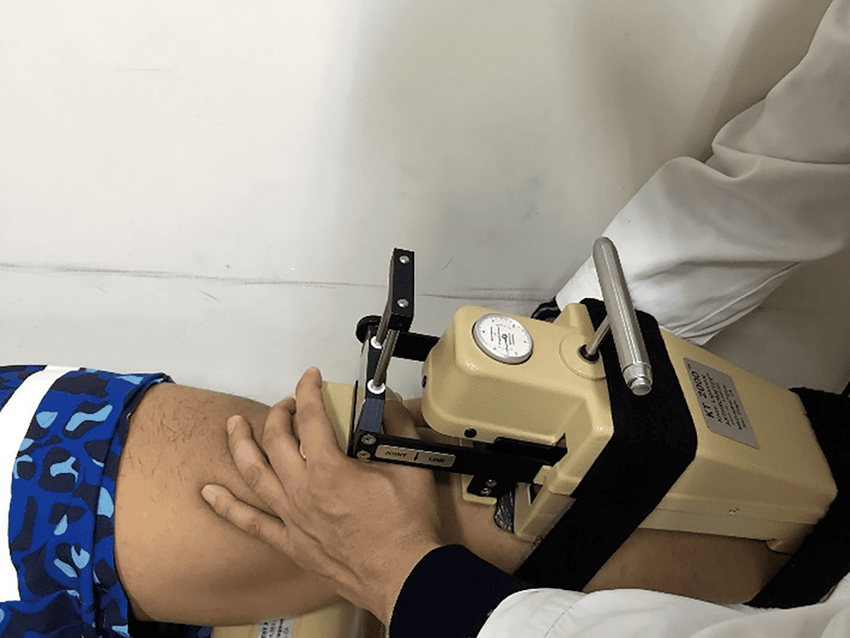
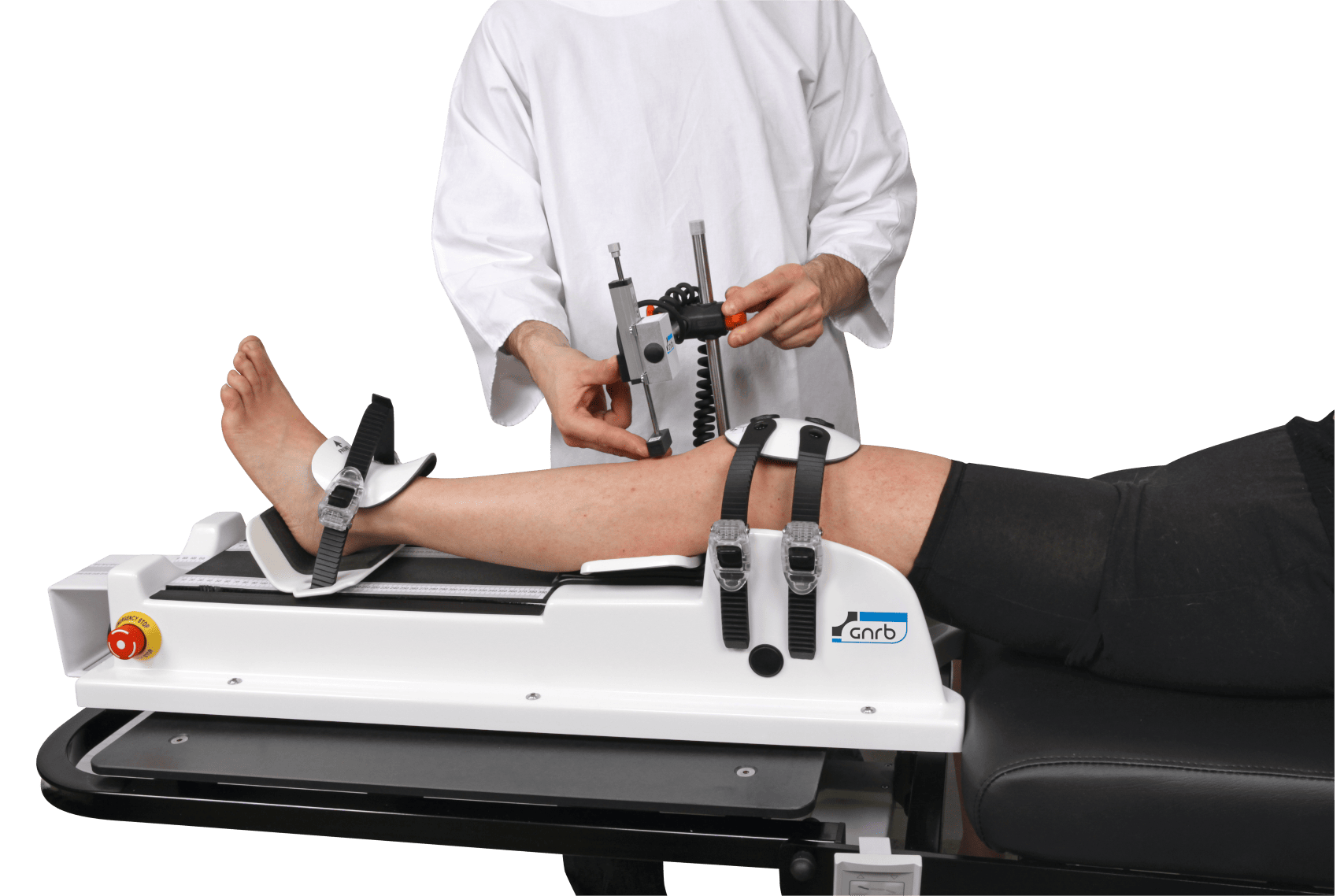
Clinicians interested in a multi-axis approach can review this multi-axis instability testing pathway. If instrumented evaluation is being considered, GNRB assessment and Dyneelax testing are examples of systems used to complement clinical examination and MRI, not replace them.
This can matter in ACL tear vs meniscus tear because meniscal lesions may coexist with measurable laxity changes in ACL-deficient knees. A relevant example is this report on lateral meniscal tears, which connects associated meniscal pathology with greater laxity in ACL-deficient patients.
6. A clinic-ready decision aid for ACL tear vs meniscus tear
In day-to-day practice, the best approach to ACL tear vs meniscus tear is not to overcomplicate the first decision. Ask which problem is dominant: instability, mechanical block, or both.
6.1 Quick decision aid
- Think ACL first if there was a pivot injury, pop, rapid effusion, positive Lachman, or positive pivot shift.
- Think meniscus first if there is focal joint line pain, painful squat or twist, clicking, catching, or loss of extension suggestive of a mechanical block.
- Think combined injury if acute hemarthrosis is followed by persistent joint line symptoms, or if instability remains after swelling improves.
- Escalate imaging or specialist review when the exam is limited by pain, MRI is equivocal, or there is concern for ramp lesion, root tear, cartilage injury, or complex multi-structure trauma.
One more pitfall in ACL tear vs meniscus tear: patients often describe any abrupt knee dysfunction as “locking.” Clarify whether this means true inability to extend, painful guarding, or apprehension from instability. Likewise, some patients with meniscal injury report “giving way” because pain causes reflex inhibition, not because the tibia is translating abnormally.
For broader diagnostic context, this article on ACL tear recognition and this piece on knee laxity can help refine the bedside differential when ACL tear vs meniscus tear remains uncertain.
7. Key takeaways and next steps
ACL tear vs meniscus tear is usually differentiated most effectively by combining mechanism, swelling pattern, symptom type, and a targeted exam. Rapid effusion and instability point more toward ACL injury. Joint line pain, catching, and true locking point more toward meniscal pathology. But many athletes and active patients have combined injuries, and that possibility should stay high on the list.
When the diagnosis is not clean, re-examination, MRI, and in selected cases objective laxity testing may help clarify whether the dominant issue is structural instability, mechanical meniscal dysfunction, or both. MRI remains complementary and is typically needed to assess associated meniscal, cartilage, and bone injury, as well as for operative planning when reconstruction or meniscal repair is being considered.
The practical next step is clinician-led: triage urgent pathology first, identify whether instability or locking is the main problem, and escalate assessment if symptoms, examination, and imaging do not align.
Clinical references (PubMed)
1) 2025 – Nguyen et al. – Value of Clinical Tests in Diagnosing Anterior Cruciate Ligament Tears: What Is New? – Rev Bras Ortop (Sao Paulo) – DOI: 10.1055/s-0045-1813005 – PMID: 41383911 – PubMed
2) 2025 – Familiari et al. – High-grade medial femoral condyle and medial tibial plateau bone bruises predict ramp lesions of the medial meniscus in patients with anterior cruciate ligament tears: A prospective clinical and MRI evaluation. – J Exp Orthop – DOI: 10.1002/jeo2.70238 – PMID: 40226534 – PubMed
3) 2025 – Batta et al. – Understanding the Ramp Tears of the Knee Joint: Types, Consequences, and Treatment. – Indian J Radiol Imaging – DOI: 10.1055/s-0044-1800805 – PMID: 40529968 – PubMed
4) 2026 – Alsedais et al. – Simultaneous Anterior Cruciate Ligament Avulsion Fracture with Bilateral Posterior Meniscal Root Tears of the Knee: A Case Report. – J Orthop Case Rep – DOI: 10.13107/jocr.2026.v16.i05.7264 – PMID: 42131024 – PubMed
5) 2026 – Moran et al. – Delayed Surgical Treatment of Pediatric and Adolescent Medial Meniscus Posterior Root Tears Is Associated With Increased Odds of Medial Tibiofemoral Compartment Cartilage Injury: A Multicenter Study. – Am J Sports Med – DOI: 10.1177/03635465261442975 – PMID: 42141718 – PubMed